Why Most AI Betting Tools Fail (and How to Actually Use AI for Betting)
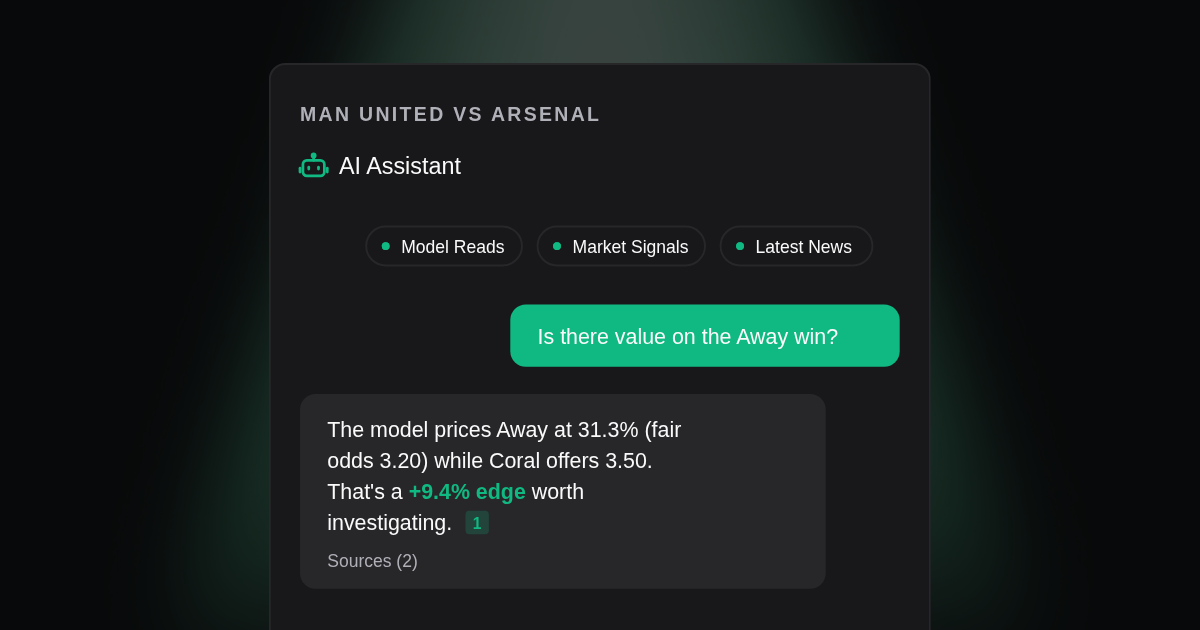
Every week, another self-styled "AI betting guru" promises guaranteed wins. Here's what they won't tell you: the hype has raced ahead of the substance. AI-branded betting services and pick promotions have become something of a trend in sports betting, yet reliable information on where AI actually helps is scarce, drowned out by overselling. This article sets out to cut through that noise and lay out, concretely, the genuine ways AI can be useful in sports betting, and what its real role should actually be.
On This Page
AI is for discovering information efficiently
AI’s answers aren’t smart enough to see every possible future outcome. LLMs are strictly input-driven; their output is bounded by whatever the user feeds in, or by whatever other sources the LLM itself is set up to reference. Users often mistake AI’s output for the smartest possible analysis, drawn from the widest possible pool of information. In reality, the result depends heavily on which inputs are deliberately fed to the model, and the scale of information an AI can actually draw on varies enormously depending on the setup, with real limits either way.
Nor is AI some all-purpose data analysis tool capable of inferring cause and effect. Predicting future outcomes requires reasoning about which past factors were decisive, and building models around that reasoning, work that demands specialist knowledge and rigorous prior validation. AI can certainly help by handling parts of this process step by step as a model is built, but this isn’t a problem with a single correct answer, so it isn’t something AI can simply take care of on its own.
Where AI genuinely excels is in gathering and organising the most relevant patterns from a vast amount of information, quickly and efficiently. Analysing a single match used to mean trawling through dozens or hundreds of sources by hand, work that could easily take four hours; AI can now get through around 200 news sources in about 30 seconds, distilling the essentials in a fraction of the time, whether that’s which side the balance of opinion favours, or where there’s a notably different view worth noting.
You still need statistical knowledge for prediction
As above, relying on an LLM alone cannot deliver causal reasoning. Take football as an example: widely accepted methods for predicting match outcomes have been developed over decades, with countless variations in how they’re applied in practice. For a broad overview, this is a useful reference: Forty years of score-based soccer match outcome prediction: an experimental review.
Simply absorbing large amounts of information doesn’t produce accurate predictions, a point many users easily get wrong. Generalising how much influence a given factor has on a future outcome, and using that to predict future events, requires a basic grounding in statistics. In particular, understanding the difference between correlation and causation is essential.
That said, AI can be a huge help in learning this material and building models around it. Attach the material you want to study and ask the AI to explain the key points or answer specific questions. The fact that anyone can pick up specialist knowledge quickly this way is a genuine advantage.
It’s also a real game-changer that models can now be built with AI’s help, without the extensive coding knowledge this used to require. Reading and writing code is precisely where AI shines brightest at this point in time.
You can’t beat the market in a numbers game
One mistake many bettors make is believing they can structurally outperform the market’s predictions. It’s certainly possible to predict a specific outcome fairly accurately using a particular model or AI. But believing this translates into consistently beating the market over time is a fantasy.
The market commands more data, computing power, and human resources than any individual bettor. Realistically, it’s close to impossible to develop or run a model that outpredicts the market across the betting market as a whole. Results from international football prediction competitions bear this out: only a handful of models ever beat the market benchmark, and even those rarely sustain it over the long run rather than a specific window.
The market’s price should therefore be used as a baseline consensus when betting. Cross-referencing which outcome the market favours, or which way it’s trending, against your own reading lets you pin down exactly where you agree and where you don’t.
The edge a bettor needs to beat the market comes from making a more detailed, more reasoned judgement than the market on specific issues within individual matches. For example, the market can, for various reasons, overrate or underrate a team’s recent form; a bettor who identifies and analyses this can arrive at a more reasonable assessment of the underlying probability than the market’s.
This is exactly where AI can offer a major advantage. It can gather the vast amount of data the market generates and quickly, effectively organise the issues a bettor needs to identify. It can then cross-check this against other sources, such as proprietary models or news coverage, helping bettors quickly identify and access the material they need for their own analysis and judgement.
Why OddsLine is the best available solution for using AI in sports betting
So here’s what those “AI betting guru” promises actually boil down to, once you strip away the hype: a set of principles any serious tool should be built on, not a shortcut around them. OddsLine is a football betting analytics service built on a clear understanding of exactly these strengths of AI. It isn’t a pick provider peddling false certainty; it’s betting intelligence designed to help anyone make competitive betting decisions in line with their own ability and resources.
Built on a RAG-based architecture, it draws on a proprietary probability model, up-to-date market information, and current news coverage, tailored to each individual match, and is designed to answer bettors’ questions on that basis. This is the kind of system anyone would need to build themselves to use AI professionally for betting, but with OddsLine, that environment is already there, ready to use, without the cost of building a data pipeline or the skills needed to build a RAG architecture from scratch.
One of the distinct strengths of a RAG-based architecture is that it curbs LLM hallucination. General-purpose LLMs answering from documents found across the internet are prone to hallucinate, driven by the model’s own degrees of freedom or by the inconsistency of the sources it draws on. Because OddsLine’s architecture draws on the latest news as a structured, RAG-based reference source as needed, with the chatbot’s parameters and prompts optimised specifically for the betting domain, it delivers noticeably higher-quality AI answers than a general-purpose LLM.
One of OddsLine’s broader strengths is its ability to process information and shape its answers differently according to each bettor’s individual needs. A bettor who favours underdog bets, or who allocates units according to risk, need only ask OddsLine accordingly to get a tailored response. This capacity to process information around countless individual needs is one of AI’s key potential strengths. Ultimately, OddsLine offers a level of systematic access to information that was previously out of reach for individual bettors, enabling anyone to make betting decisions at something close to a semi-professional standard.
Ready to find value?
Your first 10 matches are free. Full Pro experience from day one.
Start Free Trial